 Korcula Boat Tours
Getting Around Korcula Without a Car
Getting around Korcula without a car genuinely works - this is one of the Croatian islands where the car-free holiday is the normal holiday, and the evidence is in how the island is built: a walled Old Town that was finished before cars existed and has kept them out since, a bus line that strings the main settlements together, and an archipelago whose best days were never reachable by road anyway. This guide covers the whole no-car system: what Korčula Town gives you on foot, the bus lines that matter with realistic times, the boats-as-transport trick that turns a day trip into island-hopping, taxis and transfers in the gaps (there is no Uber here), the ferry logistics at both ends of the island, and the honest verdict on when a rental car would earn its keep. The short version: for a week based in or near Korčula Town, you will not miss the car at all - and the boat day you book from the Korcula boat day comparison will do more for the trip than any rental would.
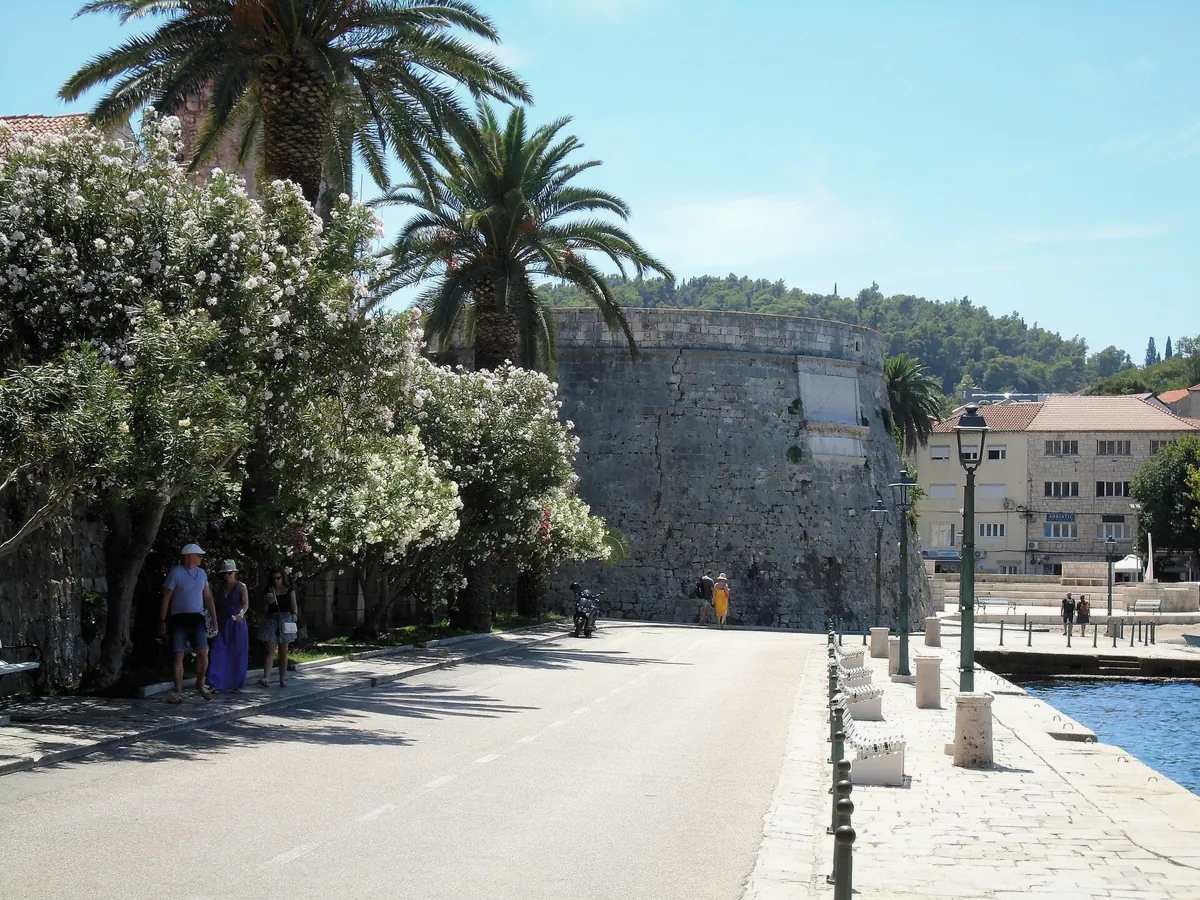
The riva under the fortress walls - Korčula Town is built for feet. Photo: Silverije, Wikimedia Commons (CC0)
Quick answer The no-car system in one answer: feet, two bus lines, boats and the ferry ports
Is a car necessary for Korcula? No, for a Korčula Town-based week. The Old Town is on foot end to end in 15 minutes; buses link Korčula Town-Lumbarda (about 20 minutes) and the Korčula Town-Vela Luka cross-island line; boats replace the car for the islands - the riviera hop-off cruise is literally transport with commentary; and there is no Uber - taxis and pre-booked transfers cover the gaps. A rental earns its keep only for far-west beaches and inland wineries on a short schedule.
Key takeaways
- Base in Korčula Town: walkability plus the bus hub plus every boat departure in one place.
- Boats are your second bus network: Badija, Vrnik and Stupe run on tour tickets, not roads.
- No Uber - plan the airport/port legs: pre-booked transfers or the local taxi stand close the gaps.
Korčula Town on Foot
The no-car case starts with the town plan. Korčula Town's Old Town is a fortified medieval grid - fishbone lanes, towers, a central square - that runs end to end in about 15 unhurried minutes and rewards the half-day it takes to know properly: the cathedral and its square, the walls walk at the waterline, the towers you can climb, the evening pasija (the promenade) along the riva. Practically for the car-free traveller: everything a week needs is inside the walk - markets, bakeries, pharmacies, beaches (the town beach sits ten minutes from the walls, with the longer pebble stretches a short bus hop east), restaurants at every price band, and the boat quay where every trip in our comparison boards.
The summer note: the Old Town's lanes carry serious foot traffic at 21:00 in August - which is atmosphere, not congestion, but it changes dinner-walk timing. And the accessibility honesty: the medieval lanes are stair-heavy in places and smooth in others; travellers with mobility needs should base at the riva level, where the flat waterfront stretch carries most of the town's practical life.
The Bus Lines That Matter
Korčula's public transport is one workhorse route and one short shuttle, and both serve the no-car traveller well. Korčula Town-Lumbarda: the shuttle that connects the Old Town to the wine village and beaches at its eastern tip - roughly 20 minutes running through the day in season, timed loosely around ferry arrivals; Lumbarda is the no-car traveller's easy half-day (Grk wine country, sandy-bay beaches, the premium snorkel yacht departs its pier). Korčula Town-Vela Luka: the cross-island line along the ridgeline road - about an hour end to end, linking the two ferry ports and the villages between; it runs multiple times daily on weekdays with a thinner weekend pattern.
Timetables shift by season and the honest advice is local: check the posted schedule at the bus station (at the edge of Korčula Town's centre) or the current Liburnija-era lines online on arrival week rather than trusting cached ones. The fare reality: single tickets cost a few euro, paid to the driver; the buses are school-bus simple, which is their charm. What the buses do not do: the south-coast beach coves and the far-west peninsula - those run on boat schedules or taxi meters instead.
Boats as Transport: Islands Without a Car
Here is the reframe that makes the no-car week click: on Korčula, the boat is not just the excursion - it is the second transport network, and the roads never competed with it. Badija, Vrnik and Stupe have no roads at all; they run on boat schedules, and the formats in our comparison double as transit: the riviera hop-off cruise is literally a day pass - a guided two-hour loop plus the right to stay on Lumbarda, Badija or Vrnik and rejoin the posted afternoon returns - which prices below a private water-taxi round trip for the same islands. The catamaran and Sail Away turn the islands into the day's plan with gear and food handled.
The Mljet exception: the national-park island to the west runs a seasonal ferry/catamaran from Korčula - a long-day trip that the bus-to-Vela-Luka leg connects nicely. The practical consequence for planning: a no-car week based in Korčula Town spends its transport budget on boat tickets, and eats better scenery per euro than any rental-car itinerary on the island. The ticket-by-ticket comparison of Korcula boat trips prices the options.
The boat-as-transport stack
Ticket formats read from the comparison, September 2026.
| Ticket | From-price | Transport value |
|---|---|---|
| Riviera hop-off cruise | $59 | Loop + all-day island hopping on posted returns |
| 3-island catamaran | $87 | Three islands, gear included |
| Premium snorkel day | $224 | Door-to-deck transfer, zero logistics |
Taxis, Transfers and the Ferry Ports
The gaps in the no-car system are few, and here is how they close. There is no Uber on Korčula - the ride-hailing map goes blank south of Split - so the gaps close with the local taxi stand in Korčula Town, phone-booked taxis from restaurants and villas, and pre-booked transfers. The legs that matter: Rorec/Korčula Town ferry port to town is walkable (15-20 minutes with luggage; a short taxi otherwise); Vela Luka port to Korčula Town is the bus hour or a fixed-price taxi; and the airport - tiny, seasonal, on the ridge toward the west - closes with pre-booked transfers or taxis, worth arranging ahead because the flight arrivals outnumber the waiting cabs.
Costs run honest island rates: short town hops a few euro, cross-island runs priced like an hour's drive anywhere in western Europe. The premium snorkel day and the seven-hour explorer fold pickup into their tickets - with pickup folded into the ticket on both - two products that treat the no-car traveller as the design case.
When You Would Want a Car
The honest verdict, because 'you never need one' is only true within its scope. A rental earns its keep for: the far-west beaches - the peninsula toward Vela Luka's outer coves and the south-coast stretches the buses never see; the inland wine arc - Smokvica, Čara, the Pošip country - on a programme of tastings rather than a single village lunch; and shoulder-season weeks when bus frequencies thin and the weather invites roaming. The counter-case that covers most visitors: a Korčula-Town-based week of Old Town, beaches-by-bus, wine at Lumbarda and islands-by-boat spends less, moves slower and sees more of what the island is actually famous for - and the boat day, which is the trip's headline, was never car-reachable anyway.
If you do rent for two or three days mid-week, rent in town (agencies cluster near the bus station and port), not at the airport, and treat the car as the access tool for the roadless-for-everyone-else corners - then give it back and let the boat day close the week.
A No-Car Week on Korcula, Day by Day
The proof of the no-car case is a working itinerary. Day 1 - arrive, walk: ferry or bridge transfer to Korcula Town, bags dropped, the Old Town on foot by evening - the walls at sunset, the riva for dinner; no wheels needed to fall for the place. Day 2 - the boat day: the archipelago from the Korcula boat trips from the town comparison, booked for early in the stay; everything boards within ten minutes' walk of the Old Town.
Day 3 - Lumbarda by bus: the twenty-minute shuttle to the wine village, Grk tastings, the sandy bays for an afternoon swim, the bus back before dinner. Day 4 - the slow day: town beach, market morning, the towers and the Moreska tradition if the season's performance calendar runs; the no-car traveller's luxury is that none of this needs a schedule. Day 5 - the second boat day or Mljet: either another format from the comparison (the hop-off cruise after a swim day, say) or the bus to Vela Luka for the Mljet ferry and the national park.
Day 6 - the west or the wineries: the day a rental earns its keep, if the group wants the far-west coves or the inland Pošip arc - rent for this one day rather than the week. Day 7 - depart: the port is a walk, the airport a pre-booked transfer, and the week closes with the note that the car never came up except on its own merits.
What the No-Car Week Actually Saves
The arithmetic that makes the case numeric. A week's car rental on Korcula in season runs roughly $250-400 with fuel and parking, plus the ferry-port logistics; against that, the no-car week's transport spend looks like this: buses - a handful of singles to Lumbarda and Vela Luka, tens of euro across the week; boats - the week's real spend, one or two tour tickets from the comparison at $59-$142 each, which were the point of the trip anyway; taxis/transfers - two airport or port legs at fixed island rates. The net saving funds the wine and the konoba dinners - and the deeper saving is friction: no parking anxiety at the Old Town's edge in August, no rental paperwork, no wrong-side-of-the-road adjustment for the third of visitors who drive on the other side at home.
The honest caveat, one more time: the south-coast coves and the far-west beaches are the car's wins, and travellers whose holiday is defined by those corners should rent - for those days, not the week. For everyone else, the island's transport stack - feet, bus, boat - covers the highlights with money left over, and the Korcula boat trip comparison is where that leftover buys the week's best day.
Arrival Logistics: Airport, Bridge and Port Legs
The no-car week's hardest hour is the arrival, so here it is in parts. By air: Korčula's island airport runs seasonal and thin; the practical airport is Dubrovnik, from which the bridge-road transfer reaches Korčula Town in two to three hours - pre-booked shuttles are the standard tool, priced per vehicle and worth splitting with another party. By ferry: the Split-side catamarans arrive at Korčula Town (a ten-minute walk to the Old Town) or Vela Luka (an hour's bus from town); the Dubrovnik-side seasonal catamaran arrives at Korčula Town directly.
By road: buses from Dubrovnik run over the Pelješac bridge to Korčula Town's bus station daily in season - the budget option that works. The luggage reality: the Old Town's lanes are carry-your-own territory; accommodation near the riva converts arrival from expedition to walk. And the timing rule that protects boat days: land the day before the water day - the transfer that overruns, the ferry that thins in October, and a 10:00 boarding do not share a morning well.
Travellers who plan the arrival leg honestly never feel the absence of the car; travellers who schedule a boat day onto a transfer morning remember it differently.
Winter on the Island Without Wheels
The no-car case survives the off-season, with adjustments. What stays open: the Old Town's year-round cafes and konobas, the market, the bakery rows, and the local buses on their winter schedules - thinner, but functional on the Korčula Town-Vela Luka line and the Lumbarda run on weekdays. What sails: very little - the archipelago day-trip season closes from November to April, the channel cruise being the last product to thin out; the ferries run their winter timetables on the mainland routes.
What the season is for: the island's actual life - winter swimmers off the town beach, the olive and citrus harvests, the towns' festival calendar, and accommodation at half the summer rate. The car question in winter: weaker than ever - the buses cover the settlements, the weather makes far-west beach missions pointless anyway, and a walkable Korčula Town with a fireplace is the season's whole pitch. The honest boundary: this is a different holiday from the boat summer - no swim stops, no lagoon hours - and travellers who want that holiday should book May-to-October and treat the Korcula summer boat trip catalog as the plan.
For everyone else: the island without a car in the off-season is the version locals would tell you to try once.
Bikes and Scooters: The Middle Options, Honestly Scored
Between walking and renting a car sit two options that half-solve the island, and both deserve honest scoring. Scooters and quads: rentable in Korčula Town by the day, they cover the south-coast coves (Pupnatska Luka is the classic run), the west-end beaches and the wine roads with none of a car's parking friction - and they open exactly the corners the buses miss. The costs: scooter-day rates below car rates, fuel trivial, licences standard car-licence territory for small-capacity machines; the honest costs: helmet hair, the August heat on the ridgeline road, and the Adriatic's mixed standard of rental machine maintenance - inspect before you pay.
Bicycles: electric rental has improved the calculus - the Old Town to Lumbarda run is flat and lovely, but the island's spine road climbs and the wind owns the west; e-bikes make the wine-village loop a half-day pleasure, pedal bikes make it a training ride. Neither option replaces the boats - the archipelago stays water-only - and neither beats the walkable base for the evening economy. The composite verdict the locals seem to run: feet plus buses plus boats for the week, plus one scooter day for the south coast if the coves are calling - and the Korcula boat comparison still owns the trip's headline.
Taxis and Transfers: The Real Numbers
Since the no-car week leans on taxis for exactly two kinds of legs - arrivals and late nights - here is what they actually cost and how to book them. The arrival legs: Dubrovnik airport to Korčula Town by pre-booked transfer runs the bridge road and prices per vehicle in the range of a half-day's car rental - split among four travellers it beats the bus on time and loses on money; solo travellers do better on the bus. The port legs: Korčula Town's port is a walk; Vela Luka is the bus or a fixed-rate taxi worth booking the day before.
The late-night reality: the island's summer evenings run past the buses, and the taxi ranks in Korčula Town price short hops honestly - the no-car traveller's one indulgence, still cheaper than the week's rental. How bookings work: hotels and konobas phone their trusted drivers (the island runs on relationship dispatch), the taxi ranks post their rates, and pre-booked transfer services quote online - three working channels, in rising order of formality. The one rule: agree the price before the door closes, as anywhere in Dalmatia - and note that the driver who handled your arrival is the right number to save for the departure.
The week's taxi spend, honestly run: less than a single day's rental, spent exactly where it buys freedom.
No-Car Questions
Is there Uber on Korcula island?
No - Uber does not operate on Korčula. The gaps close with the Korčula Town taxi stand, phone-booked taxis and pre-booked transfers (the standard solution for the airport and the Vela Luka port legs). Book the airport transfer ahead in season: arrivals outnumber the waiting cabs by midsummer.
What are the best ways to get around Korcula?
In order of use for most visitors: your feet (the Old Town and its beaches), the buses (Lumbarda shuttle, the cross-island line to Vela Luka), boats (the islands - a tour ticket doubles as transport), and taxis/transfers for the airport and the late nights. A rental car earns its place only for far-west beaches and a real wine-country programme.
Where should I stay on Korcula without a car?
In or within fifteen minutes' walk of Korčula Town - the riva, the Old Town edge or the town-beach side. That base puts the bus hub, every boat departure, the market and the evening promenade in reach on foot; Lumbarda works as a quieter second choice for beach-first families, with the shuttle as the lifeline.
Can you do a Korcula beach holiday without a car?
Yes: the town beaches sit ten minutes from the walls, the bus reaches Lumbarda's sandy bays in twenty minutes, and the boat day adds the island beaches - Badija's pebble spit, Vrnik's quarry rocks - that road-trippers cannot reach at all. The hop-off cruise is the beach-holiday hack: one ticket, three islands, return boats on a schedule.
How do I get from Korcula Town to Lumbarda by bus?
The local shuttle runs from the bus station at the edge of Korčula Town through the day in season - about twenty minutes to Lumbarda village, with stops toward the beaches. Timetables flex by month, so check the posted schedule on arrival week rather than a cached one; fares are a few euro, paid to the driver.
Is Korcula Town hilly for walking with luggage or a stroller?
The riva and the town-beach side are flat; the Old Town's lanes carry stairs in places and smooth stone in others. With luggage, the practical rule is accommodation near the water line; with a stroller, the promenade and the town beach stretch do everything, and the medieval lanes become the carry-the-child part of the day.